There's a specific kind of exhaustion I keep seeing in founders and creators right now.
They're posting more than they ever have. A few times a week on LinkedIn. A newsletter. Trying to create reels. Maybe a podcast. They bought the AI tools, built the content calendar, and they're "showing up consistently" exactly like everyone told them to.
And it's not working. Or it's working just enough to keep them doing it, but not enough to feel like it matters.
So they do the intuitive thing: they decide the problem is volume. Not enough posts. Not enough channels. Not enough consistency. They add TikTok. They double the cadence. They buy another course on hooks.
I want to save you that entire frustrating process.
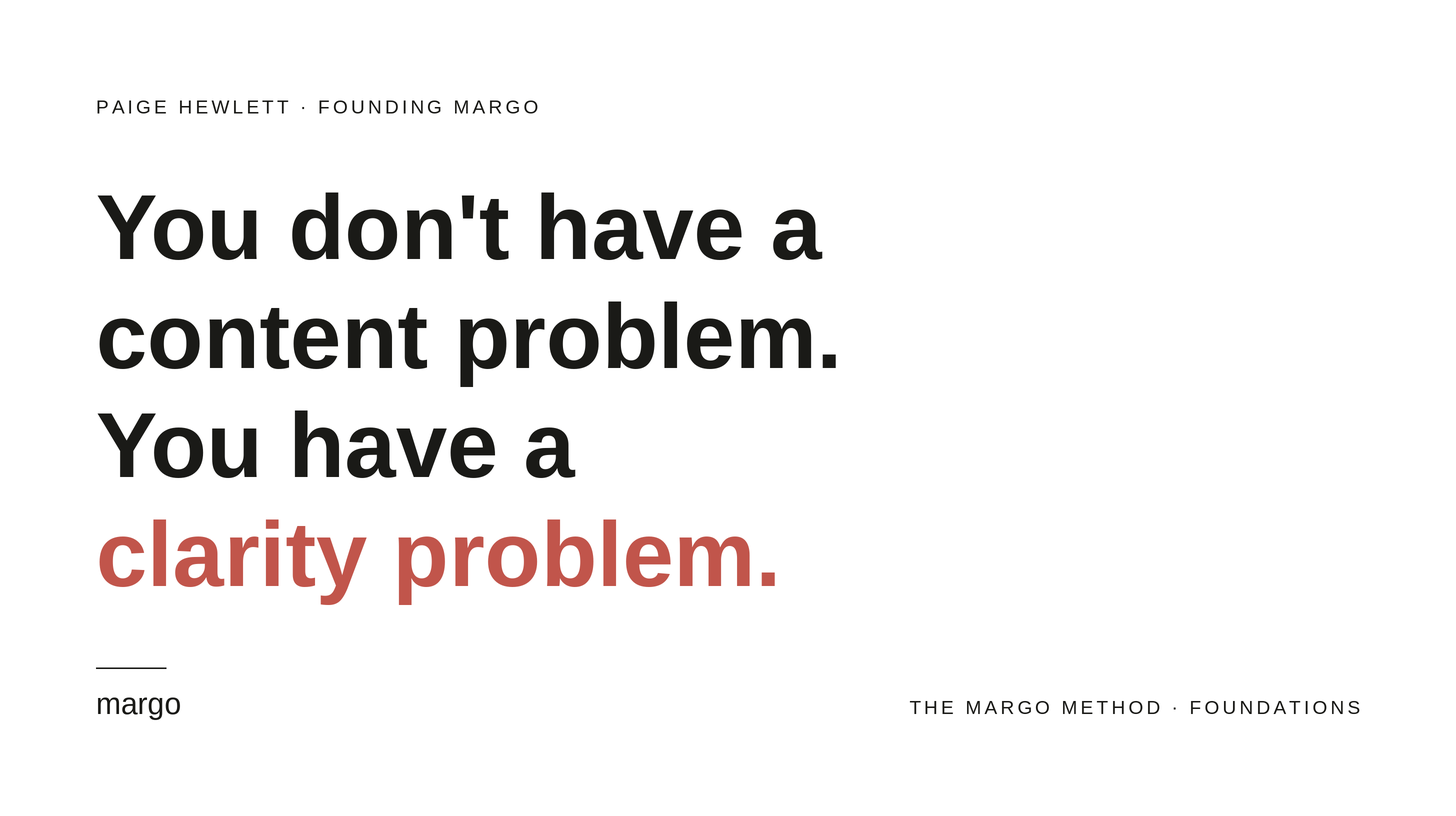
Because more content is almost never the answer. When output goes up and return stays flat, you don't have a content problem. You have a clarity problem — and no amount of posting fixes a problem that lives upstream of the post.
Why this is worse now than it was three years ago
Content used to be a little bit scarce. Writing something that connected took effort, and that effort was a filter. Now anyone can generate a competent enough post in ninety seconds. Your competitors can. Their interns can. The feed is a firehose of technically-fine, strategically-identical content, and the reader's bar for why should I care has quietly gone through the roof.
This is the thing I keep saying and will keep saying: brand is the moat in the land of AI. When production is nearly free, the scarce thing isn't the content. It's the point of view underneath it — the specific, defensible answer to three questions most founders have never actually written down.
-
What do I stand for?
-
Who is this actually for?
-
Why is my way different?
If you can't answer those in your own words, your content doesn't have a foundation. It has a frequency. And frequency without foundation is just noise you're paying to produce.
Positioning is the thing content is supposed to express
The person who articulated this better than anyone is April Dunford. Her whole argument about positioning is that most companies never actually choose theirs — they inherit it by accident, from the first customers who happened to show up, from the category their competitors already claimed. And you can't market your way out of bad positioning. You can only produce more sort-of-polished noise on top of it.
The idea I come back to constantly: positioning is context. It's the deliberate decision about how you want to be understood — what you're best at, for whom, and why that matters. In her work on the sales pitch, she pushes it further: don't open with your product. Open with your point of view. Establish the change happening in the world, then position yourself as the answer to it.
It’s not just a content tactic, it’s the thing content is supposed to express. And you can't express something you haven't defined.
What Foundations actually is
This is the first component of the Margo Marketing Method, and it's deliberately first: Foundations.
Foundations is the work of defining and documenting — actually writing down — the things you've been carrying loosely in your head:
-
Who you're for, and just as importantly, who you're not for
-
What you believe about your market that others don't
-
What change you're trying to create
-
Why your approach is different, in words a stranger could repeat back
-
The language you use, and the language you refuse to use
It's unglamorous. It doesn't produce a single post. It's the reason every post after it works. Everything downstream in the method — Reach, Engage, Convert, Delight — is built on top of it. Skip it and you're decorating a house with no frame.
What it looks like when you get it right
Anonymized, because these are real founders.
A wellness-brand founder I worked with was posting daily and converting almost no one. Her content was "good." It was also indistinguishable from forty other accounts. When we did Foundations, the thing that surfaced was that she wasn't actually for "women who want to feel better." She was for women in their first year postpartum who'd been dismissed by their doctors. Same products. Completely different point of view. Her content stopped being wellness wallpaper and started being a lighthouse. Volume went down. Conversion went up.
A B2B founder was writing thoughtful, useful posts about his category and getting polite nods and zero pipeline. His Foundations work revealed he'd been positioning inside a category his buyers didn't actually believe in. Once he named the change he thought was really happening in his market — and staked a slightly uncomfortable claim about it — the same audience started replying, sharing, and booking calls. He didn't post more. He posted from somewhere.
The pattern is always the same. The founders who feel the "content isn't working" exhaustion don't need more content. They need to go upstream, do the quiet clarifying work, and then let it run downhill into everything they make.
Before you add a channel
Before you double your cadence, before you buy one more tool: stop producing for a week (or at least a long weekend). Write your Foundations instead. What you stand for. Who it's for. Why your way is different.
Then come back to the content. You'll notice it's easier to make and harder to ignore — not because you got louder, but because you finally got clear.
That's the whole game now. Not more. Clearer.
You can get started with Margo for free - define your foundations by working through the onboarding process.