When I started the Reach stage of this series, I assumed it would be the easy part.
Distribution is the muscle I’ve used most in my career. I’ve run growth in fintech, e-commerce, cannabis biotech, and energy commodities. I know how to get a message in front of people. If any stage of my own method was going to feel like home, I figured it would be this one.
The hardest lesson of Reach turned out not to be about reaching more people. It was about who I shouldn’t be reaching, and how much of what we call “reach” was never ours to begin with.
The audience I had was the wrong audience
A few weeks ago I wrote a dispatch called “My Biggest Audience Is The Wrong Audience.”
Here’s the short version. My largest, most engaged network lives on LinkedIn. It’s built on years of work across different industries, most recently in the energy sector: colleagues, clients, and people who know me as the growth lead at a commodity risk firm. And almost none of them are the person Margo OS is built for.
When I posted about Margo there, the response was warm and polite, and it went nowhere. A like is kind. It isn’t a signal.
That was humbling, because it’s the exact mistake I’d warn a client about. I’d treated audience size as if it were audience fit. It’s one of the most common errors in small-business marketing: you go where your people already are, even when they aren’t the people who need what you’re building now.
Reach is borrowed
The second lesson took longer to settle. Every platform that shows your work to strangers is lending you its audience on its own terms.
Instagram decides who sees the carousel. LinkedIn decides whether a post travels past your first-degree network. Search decides whether your article shows up at all. Increasingly, AI assistants decide whether your brand gets mentioned when someone asks for a recommendation.
You don’t own any of it. I’m not being cynical. That’s just what these systems are, and most of them are wonderful tools. The mistake is building as though the loan were permanent. Algorithms change, accounts get restricted, formats fall out of favor, and whole platforms fade. If all your attention is rented, one policy update can take your business back to zero.
So the real question in Reach isn’t “how do I get more people to see this?” It’s “what do I do with attention once I’ve borrowed it?”
The two-slot model
This is the framework I landed on, and I now use it with every business I touch. It’s deliberately small. You get two slots.
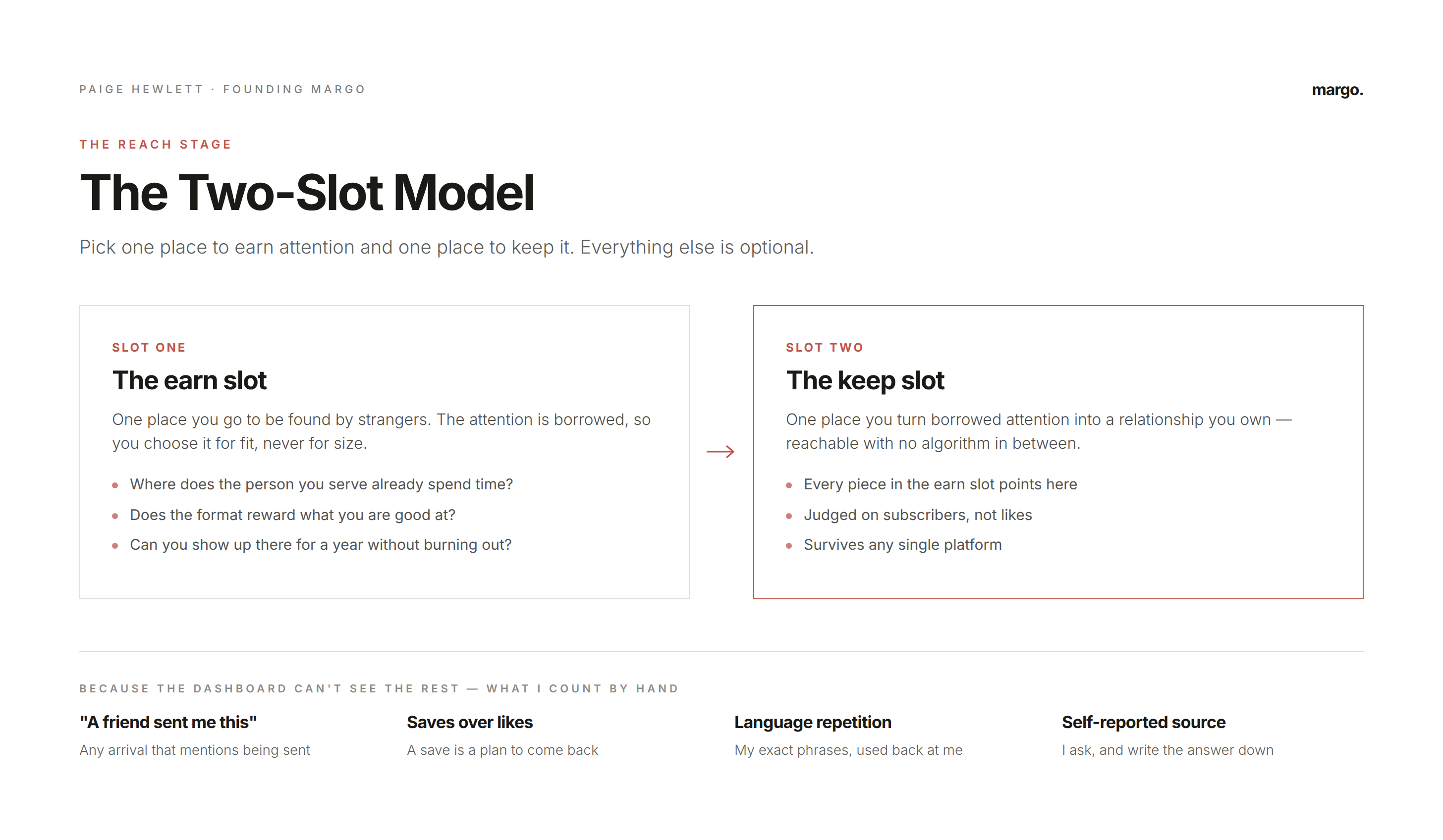
The earn slot is the one place you go to be discovered by strangers. It’s rented attention, and you choose it for fit, not size. The questions that pick it:
-
Where does the specific person you serve already spend time?
-
Does the format reward what you’re actually good at?
-
Can you show up there consistently for a year without burning out?
The keep slot is the one place you turn borrowed attention into a relationship you own. That means an email list, a Substack, a community, or anywhere you can reach people directly without an algorithm in between.
For Margo, the earn slot is Instagram. It’s where the operators I’m building for spend time, and it’s a room that rewards showing a brand system rather than arguing for one. Taste and systems are my unfair advantage, and they’re visual. The keep slot is this Substack.
Everything else is optional. LinkedIn stays, but it serves my day job, not Margo. Threads, TikTok, and YouTube can wait. “Optional” turned out to be the most freeing word in my whole strategy.
The discipline is that every piece of work in the earn slot should have a clear path to the keep slot. A carousel is judged not only by its likes but by whether it moves someone one step closer to subscribing. That’s the difference between reach as a vanity number and reach as a stage in a system.
You can’t see most of it
The dark social essay was the hardest one in this arc to write, because it meant admitting something unflattering about my own choice: I picked the earn slot that’s structurally the hardest to measure.
On Instagram, the most valuable sharing happens where no dashboard can see it. Someone sends your post to a friend in a DM. Someone screenshots a slide and texts it to a co-founder. Someone mentions you over dinner. None of that shows up in analytics, and it’s usually the sharing that actually brings in the right people.
So I stopped pretending the dashboard would tell me the truth and started counting what I can see, by hand. I track four proxy signals:
-
“A friend sent me this.” Any new follower, subscriber, or DM that mentions being sent.
-
Saves over likes. A save means someone plans to come back. It’s a stronger signal than a double tap.
-
Language repetition. When someone uses my exact phrases back to me, the idea traveled.
-
Self-reported source. When people join, I ask where they heard about Margo, and I write down the answer word for word.
They’re small numbers. They’re honest ones. I’d rather make decisions on small honest numbers than on large vanity ones, and I’d rather know my measurement is imperfect than trust a dashboard that’s confidently wrong.
Why restraint is the real Reach strategy
Most small businesses don’t fail at Reach because they’re invisible. They fail because they try to be everywhere.
The pattern is familiar. You post the same thing to five platforms. Each gets a lukewarm response. You conclude that marketing doesn’t work for your kind of business. What actually happened is that a thin signal got spread across rooms that weren’t listening, and none of them got enough of you to notice.
This matters more now than it did two years ago. Anyone can generate endless content for every channel. Volume is essentially free. What isn’t free is being recognizable: showing up in the right room, often enough and with enough point of view, that someone stops scrolling because they know it’s you before they read your name.
That’s what I mean when I say brand is the moat in the land of AI. You can’t generate your way into recognition. You earn it slowly, in one place, by being unmistakably yourself more times than feels necessary.
What Reach gave me, and what it didn’t
By the end of this stage I had a clearer earn channel, a keep slot that grows a little every week, and a measurement habit I trust. I also had a new problem.
Reach gets people to the door. It says nothing about whether they’ll stay once they’re inside. A follower isn’t a relationship. A subscriber isn’t a reader. The next stage is where borrowed attention either turns into something real or quietly drains away.
Your turn: name your earn slot and your keep slot, one word each. If you can’t, that’s the work for this week. Reply and tell me what you picked, or what’s stopping you from picking.