When I opened the Engage stage, I argued that engagement isn’t a vanity metric. It’s a signal. I still believe that. But after living inside this stage, I think I undersold it.
For a company this early, engagement isn’t just a signal about the product. It is the product. It’s the raw material everything else gets built from.
That sounds like a slogan, so let me show you what I mean.
Not all engagement costs the same
Start with the idea from the opening Engage essay, because everything else rests on it. Every form of engagement costs your audience something, and the cost tells you how much it means.
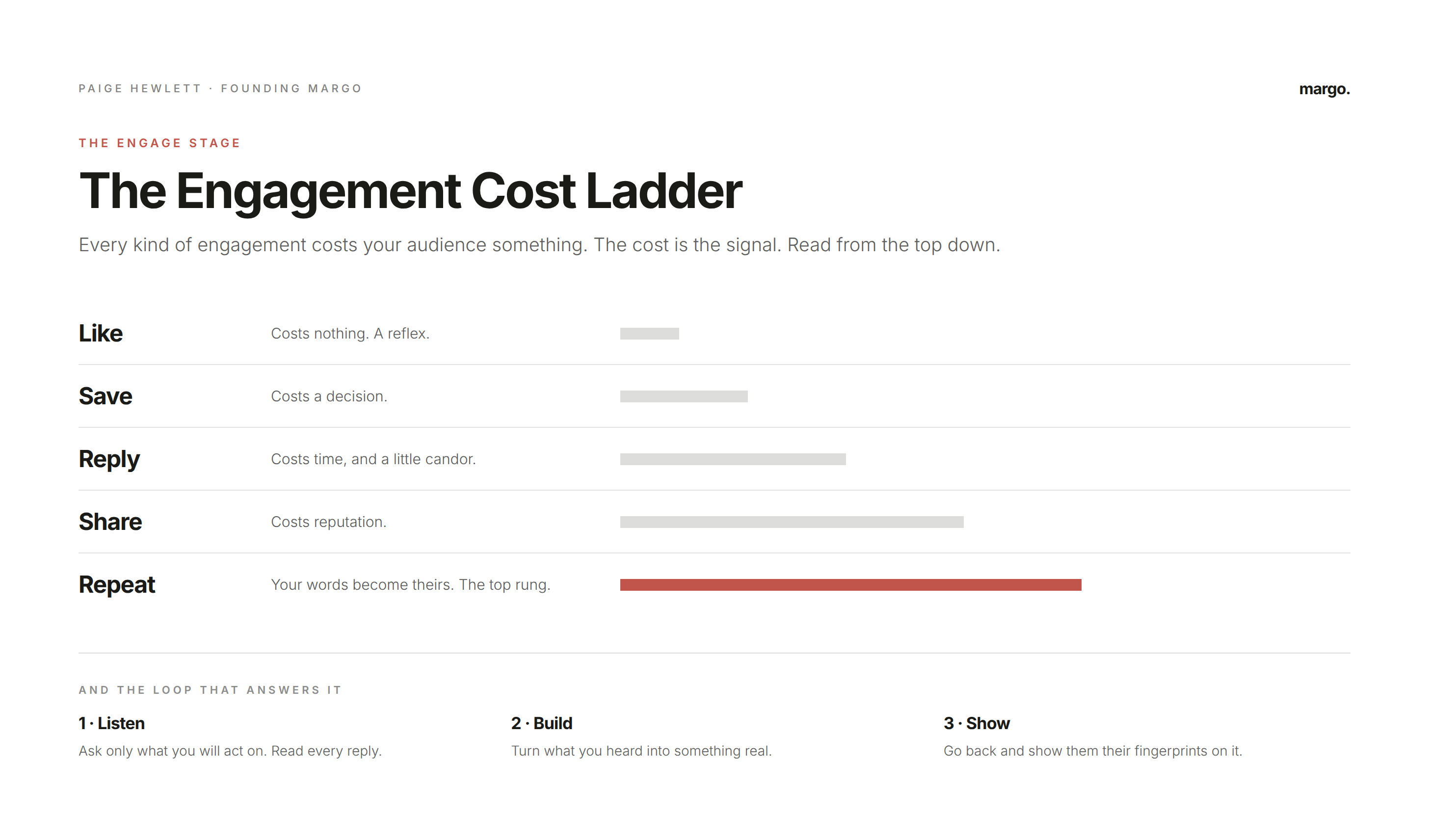
I think of it as a ladder:
-
Like. Costs almost nothing. A reflex. Nice to see, nearly impossible to learn from.
-
Save. Costs a decision. Someone judged this worth coming back to.
-
Reply. Costs time and a bit of vulnerability. Someone told you something true about their situation.
-
Share. Costs reputation. Someone put their name next to yours in front of people they care about.
-
Repeat. The top rung. Someone uses your words as their own, with or without credit. Your idea has become part of how they think.
Most dashboards weigh these the other way around. They lead with likes because likes are plentiful and flattering. But plentiful signals are weak, and weak signals make for bad decisions. If you want to know whether something is working, read from the top of the ladder down.
Harvest or answer
The standard engagement playbook treats engagement as something you harvest. Post a question. Collect comments. Reply with a heart emoji so the algorithm counts it as a conversation. Move on to the next post.
It works, sort of, the way junk food works. The numbers go up, and nothing in your business changes.
The version I’ve come to believe in treats engagement as something you answer. Someone tells you what they’re struggling with, and you actually do something about it. Then you come back and show them what you did.
That gives you a loop with three moves:
-
Listen. Ask questions whose answers you’ll act on, and read every reply.
-
Build. Turn what you heard into something real: a post, a feature, a fix, a change of direction.
-
Show. Go back to the people who told you, and show them their fingerprints on the result.
Then you listen again, and the loop tightens. Each turn builds a little more trust, because people learn that talking to you does something.
This is the one place small brands have a structural advantage over big ones. A large company has too many customers to hear any one of them. The feedback gets aggregated into survey scores and sentiment dashboards before a human reads it. You don’t have that problem. You can hear everyone. Most small businesses just don’t act like it.
Three habits that changed how I engage
Here’s what I actually do differently now.
I stopped asking questions I didn’t want answered. “What do you think?” at the end of a post is filler. People can feel the difference between being polled and being consulted. So I ask only when the answer will change what I do next, and I say so plainly. “I’m deciding between two topics for next week; tell me which one you need” gets better replies than any clever hook, because it’s true.
I keep a language file. When someone describes their problem, I write down their exact words. Not my tidy paraphrase: their words, with the awkward grammar and the specific details. That file has become the most valuable marketing asset I own. Phrases from it now run through the Margo OS site, the founding cohort page, and half the posts in this series.
It’s also a quiet argument for why brand beats volume. AI can write fluent copy all day. It can’t write copy in your customers’ words unless you’ve listened closely enough to collect them. A language file is proprietary data, and it only exists if you’ve done the work of paying attention.
I treat replies as a to-do list, not a scoreboard. Every substantive reply gets a response, and recurring questions become posts. The dark social essay exists because several of you asked some version of “how do I measure something I can’t see?” The one-channel rule sharpened because readers kept pushing back on which channel counts as “earn.” This Substack has been partly co-written by the people reading it, which is exactly how it should be.
What I heard from you
When I opened the Engage stage, I asked what marketing task you keep putting off. The replies fell into patterns I didn’t expect.
Most of you weren’t stuck on ideas. You were stuck on where things go: knowing what you want to say, but not which channel, format, or sequence to put it in. Others described a different kind of paralysis, where everything feels equally urgent, so nothing gets finished.
Neither is a content problem. Both are system problems. That confirmed something I’ve believed since Foundations: most small businesses don’t need more content. They need a structure that tells them what to do with what they already have.
Where doing it by hand runs out
The honest limit of this stage is scale.
I can hold the context for a few dozen engaged people in my head, with some help from a spreadsheet. I remember who asked what, who’s been reading since week one, and whose business is in which stage. That’s what makes the loop feel personal.
I can’t do that for a few hundred people. Nobody can, not without help.
That’s part of why we’re building Plum, the internal operations layer at Margo Labs. Plum connects contacts, customers, revenue, and products in one place, so a small team can still remember who said what and act on it. The name comes from plumbing, the infrastructure you never see until it breaks. It isn’t ready yet, and I’m not selling it here. I mention it because the need for it came straight out of this stage. That’s the loop working as it should: engagement showed me the next thing to build.
Trust is not revenue yet
Here’s where Engage leaves us.
If you’ve done this stage well, you have something rare: a group of people who believe you’re listening. They’ve told you what’s hard, and they’ve watched you respond. That’s trust, and it’s the most valuable thing a young brand can build.
But trust isn’t revenue. Eventually you have to ask for something: money, a commitment, a decision. That ask is where a lot of good brands undo everything they built in Engage. They get nervous, reach for the pressure tactics every marketing course teaches, and spend trust faster than they earned it.
Your turn: which brand has made you feel genuinely heard, not just responded to? Tell me what they did. I’m collecting examples for a future piece.