This is the stage where marketing gets its bad reputation.
Almost everything people hate about being sold to happens here. Countdown timers that reset when you refresh the page. “Only 3 spots left” on a digital product with unlimited spots. Checkout flows built so that leaving feels harder than paying. Cancellation buried six menus deep behind a phone call.
Much of what the industry calls conversion optimization is really just making it harder for people to change their minds.
I understand why. Convert is where revenue happens, and revenue is where the pressure lives. If you’re a founder watching the runway, every tactic that moves the number feels justified.
But I’ve come to believe that the tactics which squeeze the most out of this stage are the same ones that quietly wreck the next one. You can pressure someone into buying once. You can’t pressure them into staying, and you definitely can’t pressure them into telling a friend.
Conversion is where you spend the trust you earned
Here’s how I think about it now.
Everything before Convert is about earning trust. Foundations makes you clear. Reach makes you findable. Engage proves you’re listening. By the time someone reaches the moment of decision, they’ve built up a balance of goodwill with you.
Convert is where you spend that balance. Every offer is a withdrawal. The question is whether you spend it honestly, on a promise you can keep, or cash it out in one move with a trick they’ll resent later.
Funnels encourage the second approach because they treat conversion as the end. The customer drops out of the bottom, you mark the deal closed, and you go fill the top again. In that model, what the customer feels a month later doesn’t really count.
In the Margo method, conversion isn’t the end of the story. It’s the moment the relationship actually starts. So what they feel a month later is the only thing that counts.
The defensible urgency test
When it came time to decide how people would actually join Margo OS, I gave myself one rule: no urgency I can’t defend.
Urgency isn’t the problem. Real deadlines exist. Real scarcity exists. Prices really do change. The problem is invented urgency: pressure that exists only to make you decide before you’ve thought it through.
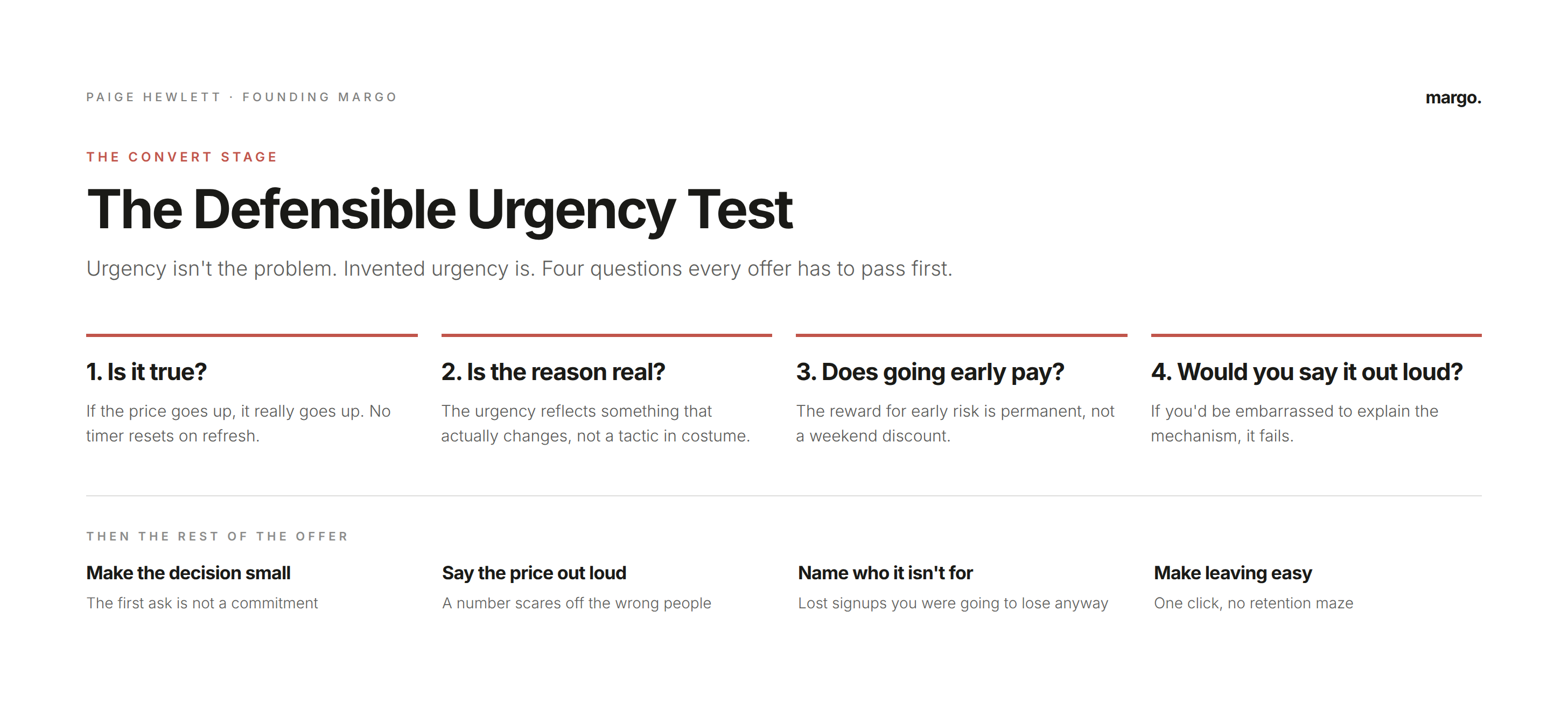
So I built a test. Before any offer goes out, it has to pass four questions:
-
Is it true? If the price goes up, it really goes up. If spots are limited, they’re really limited. No resetting timers.
-
Is the reason real? The urgency should reflect something that actually changes, not a sales tactic I dressed up as one.
-
Does the early person get something real for going early? If I’m asking someone to take a risk on something new, the reward should be permanent, not a one-weekend discount.
-
Would I be comfortable explaining the mechanism out loud? If I’d be embarrassed to describe exactly how the pressure works, it fails.
That test killed my first idea. I originally sketched the founding cohort as a fixed number of seats. It sounded exclusive and would have created instant urgency. But the scarcity would have been invented. Margo OS is software, and I could have added seat fifty-one whenever I wanted. It failed question one, and question four too.
How the founding cohort actually works
Here’s what replaced it.
Margo OS Pro starts at $9 a month. For every 25 people who join, the price goes up $10. It caps at $99. Whatever price you join at is locked for life.
Yes, that creates urgency, and I won’t pretend otherwise. The difference is that it passes all four questions.
It’s true: the price really does rise, on a schedule anyone can check. The reason is real: every member who joins makes the product more proven, since more people have tested it, shaped it, and vouched for it. Later members are buying something less risky, so paying more is fair. The early reward is permanent: someone who joins at $9 pays $9 when new members are paying ten times that. And I can explain the whole mechanism in one short paragraph, which I just did.
There’s also a free Community tier. You can see how I think, use the method, and decide whether it fits before you pay anything. That matters more than any pricing mechanic.
Four more things honest conversion requires
Pricing is only one part of it. Here’s what I’ve learned about the rest.
Make the decision small. The first ask shouldn’t be a commitment. That’s why the free tier exists. The people who convert best were rarely persuaded at the checkout. They were persuaded weeks earlier, by essays and replies and the loop from Engage. When the offer arrives, they’re just waiting for an easy yes.
Say the price out loud. Many businesses hide pricing behind “book a call” because they’re afraid a number will scare people away. A number does scare away the wrong people, and that’s a feature. The right people want to know whether it fits before they spend twenty minutes of their day finding out.
Name who it isn’t for. Margo OS isn’t for someone who wants a done-for-you agency, or a machine that generates content by the pound. It’s for operators who want a system and a point of view, and who are willing to do the thinking. Saying that openly costs me some signups. It also means the people who join are the ones it will work for, which is the entire game in the stage that comes next.
Make leaving easy. If someone wants to cancel, it should take one click, with no guilt trip and no retention maze. That can feel like leaving money on the table. In practice, a customer who knows they can leave anytime is far more comfortable staying. Easy exits are a form of respect, and respect is what keeps people around.
The slow part
I’ll be honest about where this leaves me: honest conversion is slower.
Some weeks the cohort grows. Some weeks it doesn’t move. I’m sure there are tactics that would speed it up, and I know exactly what they are. I’ve used some of them earlier in my career, and I watched what they did to the relationship afterward.
I’d rather build this at the pace of real trust than borrow against it. A business built on pressure has to keep applying pressure forever. A business built on promises it keeps gets easier over time, because each kept promise makes the next one more believable.
That compounding effect is what the final stage is about. Conversion opens the door. Whether the customer stays, and whether they bring someone with them, gets decided afterward.
Your turn: what’s the most honest buying experience you’ve ever had? And the most manipulative? I want both, because the contrast is where the lessons live.