When I opened this series with “The Funnel Is Dead,” I made a claim I didn’t fully back up. I said growth is a loop, not a line.
It was a nice sentence. It’s also the kind of thing every marketing thinker says at some point, usually with a diagram that has curved arrows and not much underneath.
Now that we’ve walked through every stage of the method (Foundations, Reach, Engage, Convert, and finally Delight), I can show you what that sentence actually means, and why this last stage is the one that makes the loop real.
The treadmill problem
Start with how the funnel treats a customer.
In a funnel, the customer is the end of the process. You spend money and time to attract them, nurture them, and close them. Then they fall out the bottom as a closed-won line item, and you go back to the top to start over.
Every month begins near zero. You need the same amount of new attention next month as this month just to stand still. If your acquisition costs rise, and they always rise, you have to run faster to stay in the same place.
That’s why so many small business owners describe marketing as a treadmill that keeps speeding up. It isn’t that they’re doing it wrong. The model itself has no memory. Nothing you did for last month’s customers makes next month any easier.
How Delight closes the loop
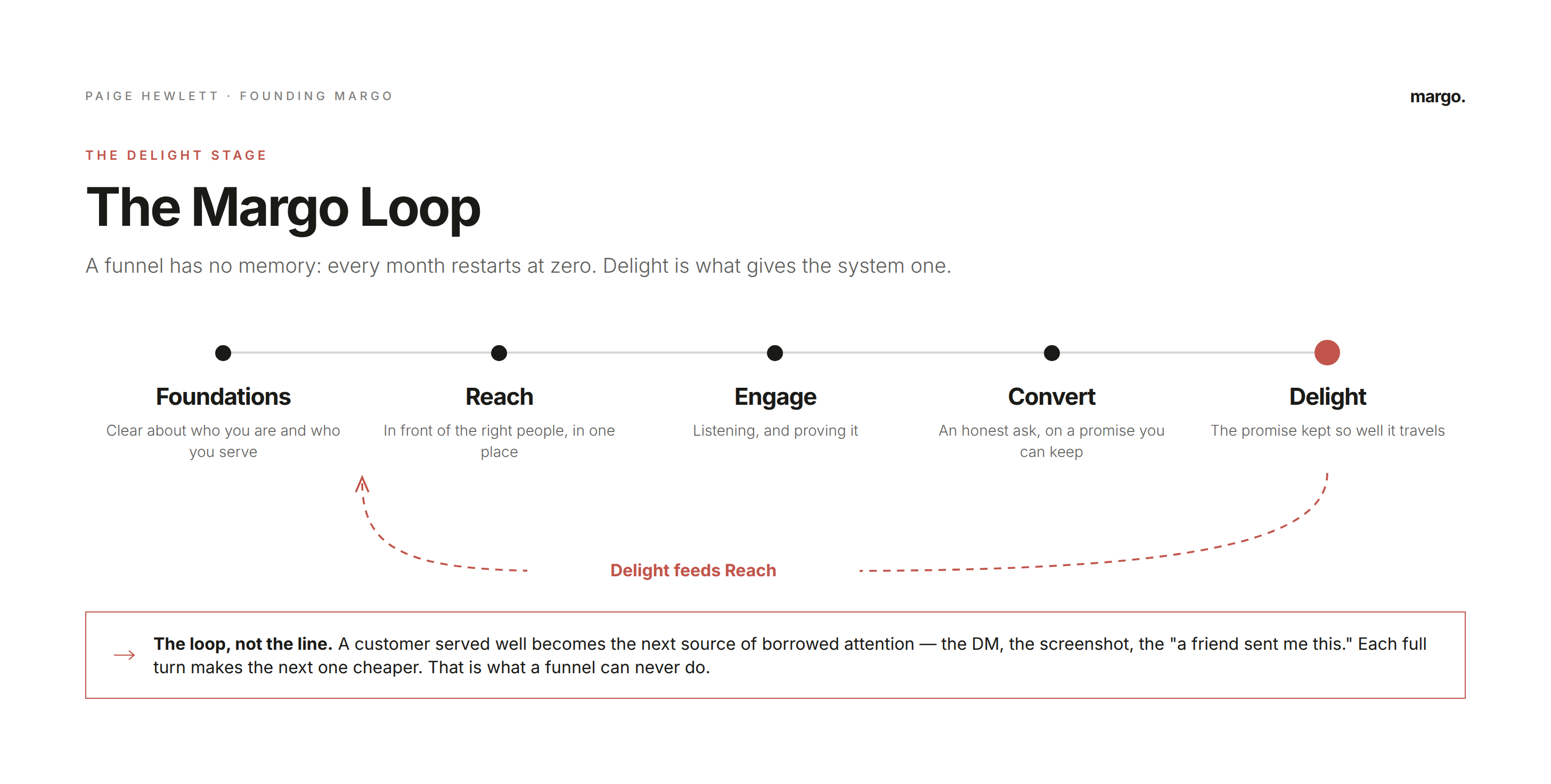
Delight is the stage that gives the system a memory.
A customer who is genuinely well served doesn’t just stay. They become your next source of Reach. They tell a friend. They share your post in a DM, the dark social channel you can’t measure but that matters most. They repeat your language to someone who’s never heard of you. They defend you in a comment thread when you aren’t there.
Remember the four proxy signals I track by hand from the Reach stage? The “a friend sent me this” messages, the saves, the language repetition, the self-reported source? Almost none of those come from ads. They come from someone who had a good enough experience to spend a little of their own reputation on you.
That’s the loop:
-
Foundations makes you clear about who you are and who you serve.
-
Reach gets you in front of the right people.
-
Engage proves you’re listening.
-
Convert asks for a promise you can keep.
-
Delight keeps it, so well that customers carry you back into Reach.
Each full turn makes the next one cheaper. That’s the difference between a business that grows and one that just keeps acquiring.
Delight is where marketing meets regenerative capitalism
This is also where two threads I’ve been writing about for a long time finally tie together.
For years I’ve written about regenerative capitalism: businesses that leave the people and systems they touch better off than they found them, instead of extracting as much as they can on the way through. It sometimes gets heard as a values statement, something nice to put on an About page.
It isn’t. It’s a growth model, and Delight is where you can see it working.
An extractive business takes what it can from each customer and moves on. It optimizes the transaction. A regenerative business leaves each customer with a surplus: more capability, more clarity, more goodwill than they paid for. That surplus doesn’t disappear. It turns into referrals, loyalty, and forgiveness when you make mistakes, which you will.
And it’s the one thing AI can’t replicate. Anyone can generate content now. Anyone can generate an onboarding sequence, a nurture flow, or a thank-you email. Nobody can generate the experience of having actually been taken care of. That requires attention, follow-through, and a point of view about what “care” means for your particular customer. That’s brand, in the fullest sense of the word.
Four moves that create Delight at a small scale
Delight sounds expensive, as if it requires surprise gifts, white-glove service, and a customer success team. It doesn’t. Most of it comes down to four habits.
1. Keep the promise you made in Convert. This sounds too simple to count, but most delight is just follow-through. The Margo OS founding cohort locks its price for life. That promise only means something if I’m still honoring it years from now, when an early member is paying a small fraction of what new members pay. That gap is supposed to exist. It’s the point.
2. Show people their fingerprints. When a feature exists because a member asked for it, I tell them. When a reply became a post, I credit it. People stay where they can see they’ve made a difference. It’s the “show” step from the Engage loop, continued after the sale.
3. Be specific, not lavish. The most delightful things I’ve received from brands were rarely expensive. They were specific: a note proving someone had read what I wrote, or a fix shipped before I’d finished complaining. Specificity is the most underpriced resource in business. It costs attention, not money, and your competitors are usually too busy to spend it.
4. Make it easy to bring someone along. If someone wants to share you, don’t make them work for it. Give them something worth forwarding: a framework they can explain to a colleague in one sentence, a graphic that makes sense without context, or an invitation they’re proud to send. Referral programs can help, but the real driver is simpler. People share things that make them look good for having found them.
The stage I’ve tested least
I’ll be honest here, because this whole series has depended on it: Delight is the stage I’ve tested least with Margo.
The founding cohort is young. I’ve kept promises for weeks, not years. I can tell you what I believe about Delight and what I’ve seen work in other businesses over my career. But I can’t yet show you the long-term compounding on Margo itself, because there hasn’t been time for it.
There’s a bigger problem too, and it’s taken me this entire arc to see it clearly.
I’ve been teaching the Margo method on the one business where I’m both the operator and the product. When I write about Reach, I’m reaching people with content about Reach. When I write about Convert, I’m converting people to a method that includes Convert. Every example folds back on itself. It’s like trying to see your own eyes without a mirror.
The method deserves a cleaner test. It deserves a business where the product has nothing to do with marketing, where the stakes are real, and where you can watch every stage happen from the very beginning.
Your turn: which brand has kept you as a customer longest, and why? My guess is the answer is rarely the product alone. Tell me the moment it earned your loyalty.