Over the last few months this Substack has walked through the full Margo method, one stage at a time. If you’ve been here since the beginning, thank you. Many of you shaped it with your replies.
If you’re newer, here’s the whole arc in one place:
-
The Funnel Is Dead. Why growth is a loop, not a line. [link]
-
Foundations. You don’t have a content problem, you have a clarity problem. [link]
-
Reach. The one-channel rule, dark social, and why reach is borrowed while attention is earned. [links]
-
Engage. Engagement as a signal, and why the reply is the product. [links]
-
Convert. Conversion is a promise you have to keep. [link]
-
Delight. The only stage that compounds. [link]
Read together, they make up the whole method: clarity, then the right room, then real listening, then an honest ask, then a promise kept so well it brings the next person in.
Every one of those essays was Margo in the third person
Here’s what the method says. Here’s why the stage matters. Here’s how I’d apply it.
That’s a reasonable way to teach something. It’s a poor way to prove it. A method described is just an opinion with better structure. And because the only business I was applying it to was Margo itself, every example folded back on itself.
From here I’m not going to describe Margo OS. I’m going to run a company on it, in public, and you’ll watch what the software actually does — the onboarding, the documents it produces, the stages as real workflows, and the decisions its intelligence helps me make. Including the parts that don’t work yet.
Meet Whole Herd Press
Whole Herd Press is a children’s publishing company I’ve started. It begins with coloring books and grows into picture books and early readers, all about the many ways people become a family.
Two moms. Two dads. Adoption. Fostering. Grandparents raising grandkids. Blended families. Single parents. Families that look like the one next door, and families that don’t look like anyone else’s.
A great many kids grow up in these families, and very few of the books in their hands reflect them. When the subject does appear in children’s materials, it’s usually handled as a Special Topic in a single careful book, rather than as a normal, everyday part of the world kids already live in.
The mission is simple to say and harder to do well: help families talk about the unique ways of being a family, give kids the words for it, and make it ordinary.
The vehicle is a recurring cast of friendly animals who show up across the whole series. The first book, The Whole Herd, is an anthology of 25 animal families, and it’s live on Amazon now [link]. Not every title is pointed. Some series will be lighter and more playful, because kids deserve joy in their books and not only lessons. The brand is built to hold both.
Why this company, specifically
Two reasons, and the second one matters more than the first.
It’s the hardest possible test of the thesis. The coloring book category on Amazon is being flooded with generated books — fast, cheap, interchangeable, published by the thousand. Many are fine. Almost none are memorable. So Whole Herd goes in with the opposite of the flood: a locked brand system, a real point of view, a cast built to recur, and a mission worth telling a friend about.
It’s a real operating business, run by one person. Books to produce. Listings to write. A catalog to plan. An audience that has never heard of me and doesn’t care about marketing.
The self-fulfilling loop
Here’s what makes this different from a case study, and it’s the whole idea.
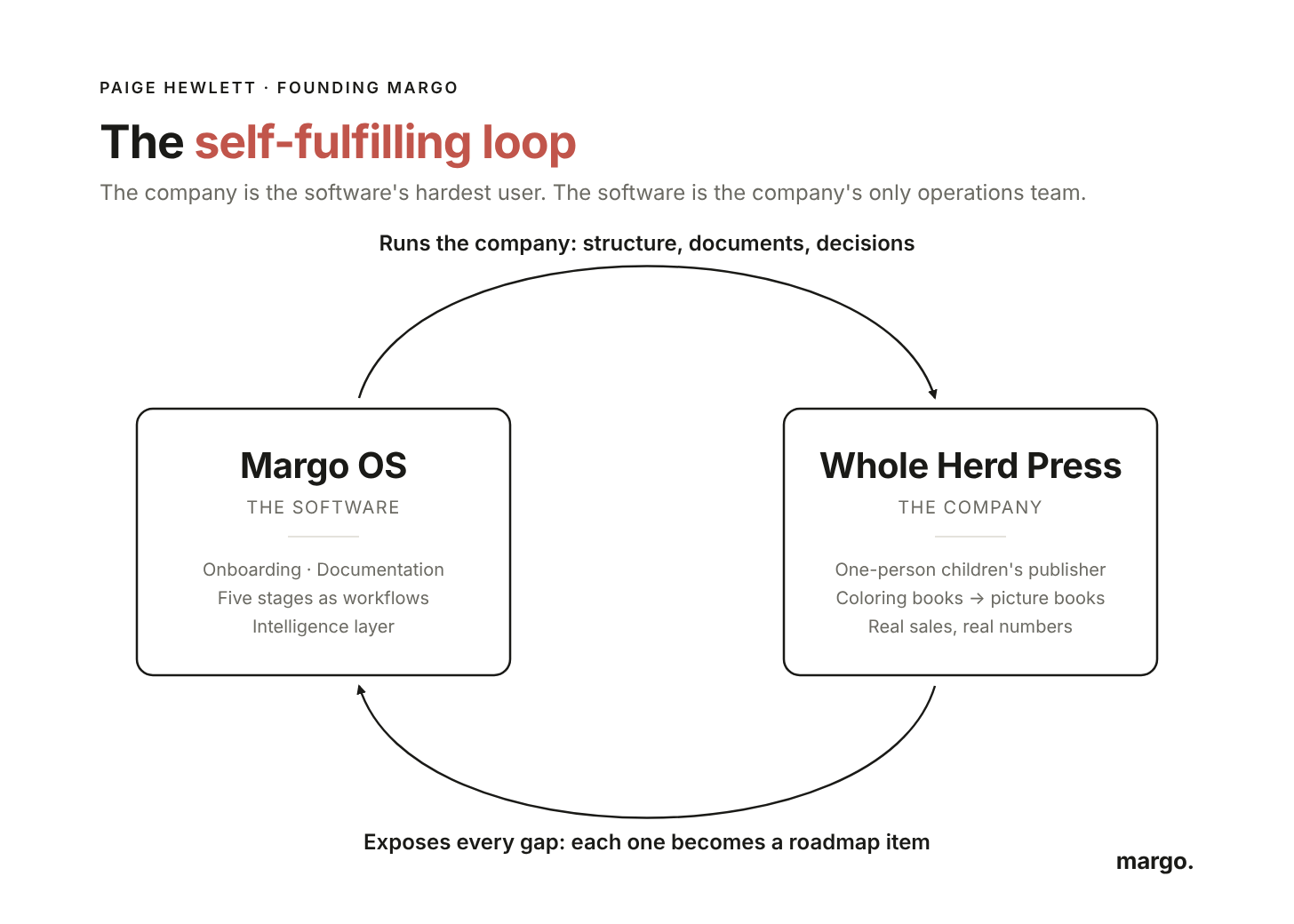
Whole Herd is going to be run on Margo OS. Not advised by it. Run on it. Onboarding, documentation, the five stages as actual workflows in the product, and the intelligence layer helping decide what the company does next.
Two things happen at the same time, and each one feeds the other:
-
Whole Herd grows because Margo OS gives a one-person publisher a system it would otherwise never have — the structure, the documentation, and the decision support that usually require a team.
-
Margo OS gets better because running a real company through it exposes everything that’s missing. Every gap Whole Herd hits becomes a roadmap item. Every feature that survives has been proven on a business with real money and real customers.
Neither is a hypothetical for the other. The company is the software’s hardest user, and the software is the company’s only operations team. That’s the loop I want you watching: a business being built by the product while the product is being built by the business.
It’s also, I think, the honest version of “eat your own dog food.” Most companies say that and mean their team uses the tool internally. I mean something stricter: if Margo OS can’t take a brand new company from nothing to a real catalog, it isn’t finished, and you’ll be able to see that for yourself.
What you’ll actually see
-
Onboarding. What it looks like to put a brand new business into Margo OS from zero — what it asks, what it generates, and where it gets things wrong.
-
Documentation. Brand, ICP, offer, positioning, written as living specs instead of vibes in my head. You’ll see the actual documents, not descriptions of them.
-
The stages as workflows. Foundations, Reach, Engage, Convert, Delight — no longer as ideas, but as things you do inside the product, with the output attached.
-
Intelligence in the loop. Where Margo’s AI helps decide what Whole Herd does next: which title to publish, which channel to commit to, what the catalog should look like a year out. Including the times I overrule it, and why.
-
The numbers. Real ones, including the small unglamorous ones. Sales, ad spend, what worked and what quietly didn’t.
When something in the product is broken, you’ll see that too. That’s the difference between running it in public and presenting it afterward.
To be clear: Whole Herd is mine. It isn’t a client and it isn’t a hypothetical, so there’s no NDA between you and the details.
One line I won’t cross
The case study is about building the business. It is not about the families these books are for.
The kids and parents who find themselves in these pages aren’t a marketing asset and their stories aren’t content. I’ll write about positioning, pricing, production, and product decisions.
How to follow along
Same place, new rhythm.
Mondays are the Margo Method: one principle, one worked example from Whole Herd, and one thing you can do that week.
Thursdays are the Whole Herd Dispatch: what I ran in Margo OS that week, what happened, and the number. The first one is next Thursday: putting a brand-new company into Margo OS from zero, including what it got wrong.
Build it alongside me
Watching is one way to follow along. Building is the other.
On October 19 I’m opening Build the Moat, a six-week live cohort where you build the same system for your own business, inside Margo OS, while I run it on Whole Herd. Two sessions a week. Each week ends with something shipped, not a set of notes. By the end you have a POV, a brand system, a channel plan, an engagement loop, a conversion path, and a retention plan, all live.
The pilot is 10 seats, each $99. It’s how the method gets its first case studies that aren’t mine.
Thank you for reading the first arc. Let’s go build the second one.
Your turn: what do you most want to see from inside a company like this — the part that case studies always leave out? Tell me, and I’ll make sure it’s in frame.